A few mates, their jet boats, a picnic lunch. It was a day out that they had done many times before.
Rob was in the passenger seat. His friend Dick was driving with Barry sitting in the back. Friends Pete and Chris were in a second boat as they explored Broken River, a tributary of the Waimakariri River.
“We were coming back down the river when the accident happened,” Rob remembers.
They hit a submerged rock, flinging the boat into a cliff face. The momentum of the crash carried the boat downstream before it wedged on a tree. It immediately filled with water.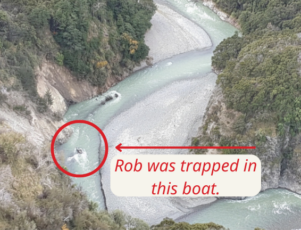
“The boat was sinking and Rob was trapped. I was able to get behind Rob and keep his head out of the water.” Dick says.
Meanwhile, Barry was tipped out of the boat and floated about one and a half kilometres downstream before scrambling to a small bay.
Chris, in the boat behind, activated his personal locator beacon. He stayed on the shore while Pete took his boat downstream to find Barry.
Kath remembers flying to the scene and seeing a man lying on a beach – it was Barry.
“There was someone with him indicating for us to go further up the river. That’s when we found Rob and Dick. We immediately knew this was bad.”
With no coverage at the scene, the rescue helicopter had to fly away to call for help. They needed a second rescue helicopter to get Barry.
“We had to decide to either leave immediately to get help or to put me down into the boat first and leave me there while the helicopter flew away,” Kath says.
It was a tough decision, but Kath says they felt it was safer for the patients for her to be in the boat, despite its precarious position. Kath was winched down.
“I did move around in the boat a little to make sure my weight wouldn’t dislodge the boat and put all our lives in danger. Once I felt OK, I detached from the winch hook and the helicopter flew away to call for back up.” Critical Care Paramedic, Kath.
Rob remembers the relief he felt when Kath was winched down into the boat.
“Water was up to my chest. Dick was doing an amazing job holding my head out of the water. I remember going down all the time and him pulling me out.” Rob Reynish
Rob’s leg was broken and trapped under the dashboard. Kath worked out the only way to free Rob was to get under the water to manipulate his leg free, then use the helicopter to slide him out.
When the helicopter returned, Kath used the radio to tell paramedic and winch operator Wayne and pilot Grant her plan. The weather wasn’t helping, with gale force winds arriving. This mission was putting the crew to the test.
“I submerged myself under the water. I felt the bone that was keeping Rob trapped. I shifted it down and managed to get it free and then fit a winch harness around him,” Kath says.
“I remember telling Rob, ‘I’m sorry, this is going to hurt’. We were pressing on his broken bones, but we had no choice. It’s rescue first. We had to get him out of there.”
Wayne was telling the pilot exactly where to position the helicopter. Wayne and Grant then had to time the helicopter’s movements just right so they pulled Kath and Rob backwards and then up, all while making sure the rotor wash didn’t rock the boat too much.
“To be able to do that in such trying conditions, in the middle of a canyon, involves an incredible amount of skill,” Kath says.
Rob was out of the boat, but the rescue wasn’t over. Kath had to leave Rob on the bank to winch Dick off the boat and rescue Chris from the shore.
With the weather closing in, the crew worked frantically to get their three patients on board.
“We couldn’t land due to the conditions, so we had to winch him up on the stretcher. I knew Rob was in pain despite the medication he’d been given, but we just had to use brute force to get him in the door. It was so windy we had no other option.”
Everyone was on board. Chris in the front seat, Dick in the back with a broken ankle and Kath trying to get further monitoring equipment onto Rob to see what they were dealing with.
“I called the hospital and that’s when Rob deteriorated. So instead of giving them a detailed description they got a brief idea that we were coming with someone with serious injuries. Thankfully the doctor who took the call realised we were in a tricky situation and had a full team at Christchurch Hospital waiting for us.”
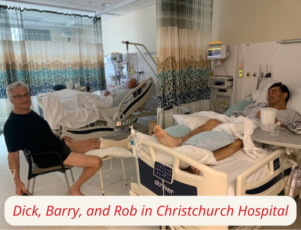
Rob spent eight weeks in hospital, with multiple surgeries required to repair his leg. Barry and Dick were also hospitalised with broken bones.
Rob was on crutches for three years. But when he was just about to “shed the crutches”, Rob had a stroke.
“My whole side was gone,” Rob says.
Living in Akaroa, Rob needed to get to hospital urgently. The Westpac Rescue Helicopter was called.
“The Westpac Rescue Helicopter saved me again. They got me to hospital in time to receive the clot-busting drugs and I’ve fully recovered. The stroke did give me terrible flashbacks to the jet boat accident. It took a long time to feel like I was back to normal.”
Today, Rob says he’s fitter than ever, a regular at the gym and he’s just bought an e-bike. But that day out jet-boating is forever etched in memories.
“The best sound I’ve heard in my life is the sound of the Westpac Rescue Helicopter coming up the river,” Dick says.
“It was one of the most challenging jobs of my career and I think about it a lot,” Kath says. “There are so many things that could have gone wrong but didn’t because the guys had all the right gear and did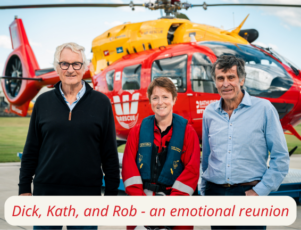 all the right things. It showcases the value of having a personal locator beacon.”
It also showcases the value of teamwork.
“We do a lot of training as a crew to be able to carry out missions such as these. The helicopter had to be in the right spot, held in that position, and then the winch operator had to put me down into an area smaller than a dinner table. It takes a huge amount of practise and it’s only by working together we can achieve that.”
Rob has no doubt he’s here today because of the rescue helicopter service – and Kath.
“The rescue helicopter service is a godsend and Kath is a goddess as far as I’m concerned. For her to go under water, not knowing what she was going to find, and adjusting my broken femur to actually get me out of there with no regard for her own life, she’s amazing. I can’t thank her or the rescue helicopter crew enough for saving my life – twice.”
Watch the video below as Rob, Dick, and Kath recount the harrowing rescue mission.
Rob and Dick have shared their story to support Chopper Appeal 2026. We need to raise $100,000 this Chopper Appeal to support the rescue helicopter service across Canterbury and the West Coast.
Can you help? Find out more and donate here.