A simple slip on a popular Canterbury walking track led to a highly technical winch rescue for Christchurch preschool teacher Zoey Plew-Smeehuyzen.
On 3 April 2026, the first day of the Easter holiday weekend, Zoey’s friends convinced her to tackle the Rakaia Gorge Walkway.
“They said it would be a great start to the Easter weekend. I’m not much of a hiker and I actually complained at the top, saying it would be nice to get helicoptered out because I was tired of walking – maybe I brought the whole thing on myself!” Zoey says.
With only about two kilometres left to walk, Zoey stepped aside on the track to let a family pass.
“I must have stepped on something like a little bank. I don’t know if I went to walk forward or just started slipping, but I heard a pop and a crack and knew something was wrong.”
A large lump quickly appeared on her leg and her foot and ankle were “floppy”.
“That’s when my friends realised it wasn’t just a sprain and called 111.”
The emergency call taker used technology to assess the situation remotely.
“The 111 call taker sent me a text with a link to my phone camera so they could look at my foot – that was quite cool. They then sent another text to get my exact location and told me to stay where I was because a rescue helicopter was on the way.”
On board the Westpac Rescue Helicopter were Critical Care Paramedic Juliet and Paramedic, Winch Operator Julian, and Pilot Regan.
“As we were flying up the Rakaia Gorge, we were very aware of the wind whipping down the gorge. We knew that if this rescue required a winch, it could be tricky.”
Paramedic and Winch Operator Julian
The helicopter landed in a paddock about 50 metres uphill from Zoey. After assessing her injuries, Juliet and Julian decided it would be too uncomfortable and difficult to carry her up to the helicopter. They splinted her leg, administered pain relief, and prepared to winch her out.
Juliet remained with Zoey while Julian returned to the helicopter to operate the winch.
“Zoey was on the track halfway up the gorge, which meant it was going to be a high winch. We had to go high to get out the mechanical turbulence from strong winds passing over the trees and terrain,” Julian says.
A typical winch rescue is conducted from between 30 and 50 feet (9–15 metres). The highest winch Julian had previously been involved with was 100 feet (30 metres).
Zoey’s rescue required a 200-foot (60-metre) winch.
Julian’s job was to lower the winch hook from the helicopter to Juliet, who would then attach both herself and Zoey to the cable.
“We had to lower the cable through a gap in the tree canopy. Because we were so high, the hook started to swing. We had to move the helicopter forward to compensate for that movement, allowing the hook to pass through the canopy and into Juliet’s hand.”
The next challenge was bringing Juliet and Zoey safely back up to the helicopter.
“Getting them through the canopy involved working closely as a team and using all our experience to control the winch, minimising any swing or spin as we brought them up.”
Once they had cleared the trees, the helicopter moved out over the river and away from any obstacles. Juliet and Zoey were winched up to the helicopter before being flown back to the paddock, where the crew prepared Zoey for transport to Christchurch Hospital.
“It was definitely a challenging and technical job, but Zoey handled it so well,” Julian says.
Although normally comfortable with heights, Zoey says being winched from a track and suspended over a river was an entirely new experience.
“Julian and Juliet were so amazing. Even as I was hanging off the side of the helicopter on
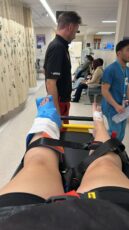
Zoey arriving at Christchurch Hospital with Paramedic Julian
the way back to the paddock, they were chatting to me and keeping me calm. I remember saying, ‘Wow, you’re really good at your jobs.’”
Zoey spent a week in hospital and underwent surgery to repair three broken bones in her lower leg and
foot, including injuries to her tibia, fibula and talus. She then moved back in with her parents during her recovery, where her father found himself caring for both Zoey and her mother, who had broken her ankle just three weeks earlier.
“Dad did a great job taking care of both of us!” Zoey laughs.
Three and a half months after the accident, Zoey was excited to return to work.
“I definitely have a good story to tell the preschoolers about my rescue helicopter ride.
“I just want to say thank you to Juliet, Julian and the rescue helicopter crew for handling my accident with such care.”
“I never thought I would need the rescue helicopter service, but I’m eternally grateful that it was there for me.”
Inspired to support this life-saving service?